This week I am at NCTE, my favorite conference every year. It is in Atlanta, and since this is my first time in the southern city, I did a bit of sight seeing before opening session. When I arrived, I met a friend and our first stop was the Center for Human and Civil Rights Museum (https://www.civilandhumanrights.org). Before I walked in the door, I felt great about visiting this museum in the face of all the hatred I've seen spreading across our nation since Trump's election. By going to the museum I was supporting those who have experienced prejudice and struggle, I was proud of myself.
I had no idea just how much that museum would affect me.
Not only is the museum full of incredible information and powerfully created exhibits, it also gave me the chance to experience something I could not experience as a white woman. I sat on a stool and had one minute and forty-five seconds of simulated fear.
The museum has a sit-in counter experience where you are shouted at, the seat is kicked, and with your eyes closed you can feel the fear and hatred and anger that surrounded the brave young men and women who sat at those counters. The experience was an interactive one, but I was never in any actual harm. No one touched me and no food or spittle was thrust upon me. Regardless, I walked away in tears.
I found myself wondering, if I had been alive then and had the opportunity to support those of color or lesser privilege than myself, would I have been able to do it? Would I have been allowed? Would I have had the strength to defy my parents to stand up against injustice? Would I have been willing to be arrested in order to march? Would I have been willing to be beaten in an attempt to stand with them?
I hope I would have, but it scared me. I think of myself as someone who will readily stand up for those I see being treated badly or those who are in danger. I am not afraid to speak out about the way I see students treating each other if they are speaking hate or bullying. I am not afraid to speak my mind when I see others acting out of line. I don't even think I'm afraid to lose my job if it means standing up for someone who has been treated inappropriately, with prejudice, or with hate.
What scared me the most, and it has been running through my mind, is that as intelligent as I am, I truly have no idea what it is like to be targeted, harassed, judged, and hated. No matter what I read, or discuss, or learn about, I will never know what that feels like in real life.
My minute and forty-five seconds at the interactive sit-in counter may be the closest I ever come to understanding that experience.
This morning, I listened to seven authors speak about advocacy. Some authors I have read and love their work, because I see it as important and something every student should read. The others, I had yet to discover. As I listened to their discussion and answers about advocating for change and children, I began to cry again.
Sharon Draper said that there needs to be more people writing diverse books than just the authors on the stage. She implored the teachers in the audience to write. "Write that book" became the mantra of the morning. I found myself wondering what I, as a white, middle-class woman, could possibly add to the world of diversity. I also found myself teasing the idea of writing a book with my students about what it is like to live, diversely, in a mostly conservative area of Texas.
Jason Reynolds, who wrote the amazing and powerful All American Boys (seriously, everyone should read this), said that black children need to stop hearing that the way they speak is wrong. I found myself wondering if I had ever told that to a child in my classroom and hoping that I taught them the difference between formal and informal English as opposed to correct or incorrect.
Ibtisam Barakat, not only told us about her fears for the Muslim people in America, but also about how writing saved her life. She told us that harmed people who don't have the chance to heal will harm others. She is right, without healing and growth none of us can move past old wounds. When she advocated for the pronunciation of her name, I realized that so many of us don't take the time or effort to truly honor the name of a child and I was pleased when everyone in the audience said her name allowed. Our names are the first part of honoring us as people.
As I continue to grow as an educator and (hopefully) leader in my field, I hope that I can become more knowledgable and outspoken about the importance of advocacy, civil rights, and standing up for those whose voices have been weakened. I hope I can make my friends who are in a daily struggle to be seen as equal, human, and worthy proud. I know that I see them as equal, human, and worthy.
My struggle is less about the cause and more about the internal questions I have running through my mind: Am I doing enough? Am I strong enough?
I have come to the conclusion, although it may be temporary, that I am. I may not be involved in marches on Washington, but I am involved in the public discussion through social media, how I treat my students, and my writing. I can be strong enough to work daily to teach students how to agree to disagree, work through differences, and see each other as people. The best way for me to affect change is in my classroom and through each and every heart and mind that I can tough.
I told my students the day after the election that change does not start at the top, it begins with them and their younger sisters and brothers. If they want to see a different world in the future, they have to begin acting on it now. I firmly believe that is true. A change at the top, does not change hearts, although it may enrage minds.
This I can promise every student in my classroom: I will learn how to properly pronounce your name and ask you how you wish to be addressed. I will seek out literature that reflects your life. I will stand up for you if you are being mistreated. I will push you to learn how to use your own voices. I will continue to cry for those who I cannot directly help. I will continue to encourage and have faith in the young men and women in my classroom. I will not stay quiet when I see an injustice. I will protect you as muc
h as I am able. I am on your side, I will stand with you. I will love you. I will question you. I will hear you.
I'm not sure what else I can do. I am not in danger. I do not live in fear. I do not question my insurance, ability to marry or raise children. I do not wonder where my next meal will come from. I do not wonder whether or not police will stop me just for wandering through a store.
The only answer I have truly come to is: Teach me.
Friday, November 18, 2016


Wednesday, February 24, 2016
Role-play in the Classroom
I love doing role-play with my students, and they seem to really enjoy it too. When we play role-play games with a text, it gives them the chance to experience something in the text, usually something there is no way they could actually experience in life. I have found that those role-play activities help my shy students come a little further out of their shells, my confused students clear up their thoughts about the text, and my leaders step up and take charge. It is really a rewarding experience for all.
One of my very favorite role-play activities happened in my classroom last year. My students and I were reading To Kill a Mockingbird by Harper Lee, and I had just begun to experiment with using drama pedagogy for an entire text instead of just in bits and spurts. When my students came into class that day, they were each handed a character from the novel and then segregated accordingly. I informed them that we were going to have a town meeting and had to decide on several things, but we had to decide on them together. I also informed them that since we were role-playing and they were all characters from the text, they had to be segregated and also had to think carefully about how that character might actually respond in a town hall meeting at the time.
One class period got into the role-play deeply. There were lewd comments from the Ewell father, the reverend attempted to stand up for the Black community in the town, and the teacher who had just moved to town was not trusted and ended up losing wages. What my students discovered during the role-play, especially my students who had struggled with the text, was that the town would never really be able to make a decision together. The student playing the reverend who had simply tried to stand up for his community ended up being taken to jail for his own safety from Mr. Ewell. In that one class period, my students began to understand the world of the novel much more realistically and deeply than if they had just read the book. For many in that class, it was eye opening to see what the community of Maycomb was actually like.
Role-play does not have to be something that you have planned out weeks or months in advance, it can be something as simply as our town hall meeting; however, you do have to be prepared for whatever the students might say in role. My student playing Bob Ewell knew that the character was a drunk and rude man, and I fully expected the student to play the part appropriately to the character; he didn't disappoint.
When planning a role-play for your students, always start with a goal. If you don't know what you hope to get out of the activity, it will quickly deteriorate from a learning experience to students getting off track and into their own conversations. You also need to tell the students you are going to do a role-play and lay out the rules and expectations of it clearly. If you are engaging in a role-play that may make students uncomfortable, have a specific phrase you will say if things get out of hand. I am a fan of telling them that "stop" or "freeze" are my words. If students hear me say the word, they must immediately respond. Since I explain that the word is meant to keep the role-play focused and people from being uncomfortable or concerned for themselves, the students have always understood and complied.
I encourage you to see what type of role-play you can add into your next novel study. I promise it will help the classroom discussion of the text be much more interesting and engaging.
For more ideas or for a drama pedagogy unit, visit my Teachers Pay Teachers store: https://www.teacherspayteachers.com/Store/Channeling-Ms-Frizzle
Thursday, February 11, 2016
Writing in Role
I love using writing in role with my students, it is good for all of them and always fun for me to read. There are several ways you can do writing in role, and I feel like I've tried them all. I've asked students to write a letter home telling their parents what it's like in a situation. I've asked students to write short pieces talking about a specific event from the text and how there character feels about it. I've asked students to write as a character who is a part of the story but not actually a part of the plot (i.e. a Nazi in The Book Thief by Markus Zusak).
When students write in role, they are doing more than just writing something on a piece of paper. They are making inferences, they are testing their comprehension of a story, they are exploring characterization, and sometimes they are identifying themes and nuances within the story. Their writing shows you how well they are actually understanding the text.
Below are a few examples from students past and present. Not all of the writers are strong writers, but each was able to achieve the goal of writing in role.
The first two are from reading Lord of the Flies by William Golding with a sophomore class. The students were asked to write as a character from the novel and explain how that character feels about life on the island.


The next example is from a senior class several years ago that had read The Strange Case of Dr. Jekyll and Mr. Hyde by Robert Louis Stevenson. This writer had always had a wonderful imagination, but had often struggled with the conventions of writing. In this piece, she speaks as each of the three primary characters in the novel.

You'll see that none of the pieces is perfect, that is not the point of writing in role. The goal of writing in role is to help students explore a text and share their ideas about it. The goal is also to give you the chance to really see how well they are understanding the text.
Writing in role is one of my favorite writing assignments to do with students and can be done with ANY text.
As we near the end of the semester and the testing season (at least in Texas), I recommend you try some writing in role with your students. I can almost guarantee you will have high engagement from them!
For more information or ideas, visit my Teachers Pay Teachers Store! https://www.teacherspayteachers.com/Store/Channeling-Ms-Frizzle
Wednesday, February 10, 2016
The Games We Play - Using Drama Pedagogy in My Classroom
Play has always been an important part of learning for people of all ages. Many of us only truly learn something when we get to "do" it and make mistakes, play is the basis of the "doing". In my classroom, like in many around the world, I have students of all levels. Students I want to reach. Students I want to help enjoy the learning process. Students who may not be reading at a high school level, yet are in high school and nearing graduation.
I find I am able to help those students in many ways when I introduce drama pedagogy activities to them as we read novels in class. My students enjoy the novel, they enjoy getting to "interact" with the characters and the story, and for many of those students who have never before been able to think deeply about a text, they can make inferences and support their ideas. All through the use of playing with drama pedagogy.
My dissertation is on that very subject, using drama pedagogy in the secondary classroom.
Too many of us want to incorporate some fun and play into our classrooms but may not know how to do it. For that reason, I have decided to write a small series on the blog about how I have used different drama pedagogy activities in my classroom in the hopes of inspiring you to incorporate some of them into you classrooms!
I hope you enjoy and I hope you are able to begin to play in your classroom some!
If you would like to purchase some drama pedagogy units, please visit my TeachersPayTeachers store!
https://www.teacherspayteachers.com/Store/Channeling-Ms-Frizzle
Thursday, December 3, 2015
Overcoming Sadness When It Drags You Down
Unless you ignore the news completely, you are aware of all the shootings and violence happening in our world recently. Yesterday it finally got to me, and it grabbed hold of me tightly. I was finishing up tutorials where one of my boys had come in to work on his writing portfolio. I clicked on my Facebook app and saw the news about the shooting in California. He and I were both shocked, and I left school feeling like I needed to cry.
This morning I felt it even more heavily, especially since the news seems to have a constant stream of updates and new information. I am thankful for the news. I am also disgusted and saddened that this has happened yet again. I know something needs to be done, but I am not at all confident that anything will be done anytime soon.
That sadness has permeated my world today and I needed to do something about it. My students write in their journals every day to a specific prompt word, their journal writing is also supposed to be in a specific style. I decided that I needed my kids to help me see some light in this all too dark world. It has been my experience that when I am down or feeling the horrors of the world close in on my heart that my kids are most often the ones to help me through it and into the light of hope.
So, instead of writing a journal prompt today, here is what I put up on the board:

Like always, they came through. Here are just a few of the beautiful notes my kids wrote and will then spread to random people in the hallway today. I love that so many of them have added the phrase "pass it on" somewhere on their cards. I even had several who wanted to do more than one.


When you feel down, let your kids know. It's important they see you as real people, and they will usually take an extra few minutes to help bring you up.
This morning I felt it even more heavily, especially since the news seems to have a constant stream of updates and new information. I am thankful for the news. I am also disgusted and saddened that this has happened yet again. I know something needs to be done, but I am not at all confident that anything will be done anytime soon.
That sadness has permeated my world today and I needed to do something about it. My students write in their journals every day to a specific prompt word, their journal writing is also supposed to be in a specific style. I decided that I needed my kids to help me see some light in this all too dark world. It has been my experience that when I am down or feeling the horrors of the world close in on my heart that my kids are most often the ones to help me through it and into the light of hope.
So, instead of writing a journal prompt today, here is what I put up on the board:
Like always, they came through. Here are just a few of the beautiful notes my kids wrote and will then spread to random people in the hallway today. I love that so many of them have added the phrase "pass it on" somewhere on their cards. I even had several who wanted to do more than one.


When you feel down, let your kids know. It's important they see you as real people, and they will usually take an extra few minutes to help bring you up.
Thursday, October 15, 2015
Entering the World Wide Web
As a teacher, it is often incredibly hard and time consuming to create and build things to use in the classroom. Most of us have created things that we used once and didn't like how it worked so put it away to either fix later or never look at again. I try to adapt things quickly, and because of that I have things to put out into the world via the Internet.
I've also realized recently that I have to start repaying my student loans soon (ugh). I have almost $100,000 in student loans, BUT it has gotten me almost three degrees (I will be a doctor in 2016), and IT WAS WORTH IT!
When I discovered I'd have an additional bill soon, I freaked out some. I mean, come on, I'm a teacher and we don't make that much money...and I get paid once a month. Until I remembered the awesome site, teacherspayteachers.com. I've had a store on there since 2010 but never made very much money, so I went to one of my coworkers who is a superstar there and got some advice.
For the past week or so I've been working to make my store more appealing and increase my goods (something I'm still working on doing). I'm actually really pleased with how I've rebuilt things and have increased my followers some - but I'd like more (hint hint hint).
A teacher store like this is something I believe all teachers should have in their tooldbox, there is no reason for us to reinvent the wheel, sometimes we just need to change its color.
Please stop by my store and see if there is anything that would be useful to you, if not I'm happy to take suggestions and of course encourage you to visit other teacher stores!
Monday, August 24, 2015
It Begins!
My 12th year in the classroom began today, and my feet are killing me! Like always, I choose a first day of school outfit that I think is adorable, this year it is one my husband picked out for me. The shoes I wore however tried to kill me (and they had never been uncomfortable before)! Tomorrow I will be wearing my trusty flats!
As my students from last year stopped by for hugs and to say hi, I got lots of compliments from them on the changes I've made to my room. They all noticed the additions of color and arm chairs, several were jealous I didn't have them last year. It thrilled me to have them appreciate the hard work I put into making my room more cheery. Many of my new kiddos also complimented my room and I'm sure they are ready to use the arm chairs on Friday when we read independent texts (thank you Donalyn Miller!).
Something that surprised me is how many of my new students feel like the charging station I've added is a total bonus for them. It is really just so I have an additional place to keep their cell phones, which I will take up each day. I discovered last year that if I collect phones during class, we have better discussions and an overall stronger learning experience.


I have also been working on making sure I eat well this year, including doing food preparation on Sundays so I don't just come home and eat popcorn (something my husband thinks is all I eat when he isn't here). So far so good! I bought a bento box style luck box and it has been working on really well. I am even finding that I can't finish my lunch (which gives me a snack for after school!).
As the week continues, I will have to get back on track and continue to work on my comps for my doctoral program. I have set several deadlines for myself this semester, and am hoping that the plans I have put into place will help me stay on top of things and meet all of my deadlines.
To my fellow teachers, have an outstanding year!
Tuesday, July 21, 2015
Preparing for the year (or an ode to Pinterest...and my mother)
I've had a busy summer, and have loved just about all of it. The only part I haven't enjoyed was starting the summer with a diagnosis of a gallstone that has been a part of my life for about 20 years! It has affected me so much this summer I even gave it a name, Hugo. Hugo will be coming out at the beginning of August, which means I'll be in recovery during my first week back at work (thankfully we won't have kids there yet). I am also in the proposal stage of my dissertation, which means I'll be doing lots of travel and research and writing this school year, so I'm trying to build everything I possibly can to make my life a little less stressful.
Because of all of those things, I have already begun redoing my classroom.
I decided last year that I wanted a couple of reading "nooks" in my room; I had several kids who loved sitting in the back of the room when I had desks there. I have also decided that Fridays will be independent reading days for my kids and have stolen Donalyn Miller's rule of books to read for the year (and adapted it for my skeptical darlings). My kids will have 30 texts to read this year, 15 of which are magazine articles (to make it less scary and harrowing).
Here is where Pinterest comes into play!
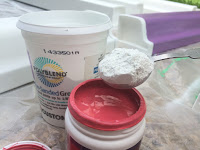
Once I decided I wanted my kids to read so much more on their own, because seriously the best way to become a better reader is to read like a fiend, I realized I wanted a way to display different genres at different times. So I started exploring Pinterest. I found several pins about using rain gutters for houses as small shelves in their children's rooms. I also found a way to make my own chalkboard paint. I put the two together and prayed it would work. I was able to find all the supplies I needed at my local Home Depot, and didn't need to buy whole gallons of paint. They have sample sizes you can buy for something like $3.00 (seriously the best way to paint things for the classroom).
 The beginning of my first project for the classroom this summer.


Because of all of those things, I have already begun redoing my classroom.
I decided last year that I wanted a couple of reading "nooks" in my room; I had several kids who loved sitting in the back of the room when I had desks there. I have also decided that Fridays will be independent reading days for my kids and have stolen Donalyn Miller's rule of books to read for the year (and adapted it for my skeptical darlings). My kids will have 30 texts to read this year, 15 of which are magazine articles (to make it less scary and harrowing).
Here is where Pinterest comes into play!
Once I decided I wanted my kids to read so much more on their own, because seriously the best way to become a better reader is to read like a fiend, I realized I wanted a way to display different genres at different times. So I started exploring Pinterest. I found several pins about using rain gutters for houses as small shelves in their children's rooms. I also found a way to make my own chalkboard paint. I put the two together and prayed it would work. I was able to find all the supplies I needed at my local Home Depot, and didn't need to buy whole gallons of paint. They have sample sizes you can buy for something like $3.00 (seriously the best way to paint things for the classroom).
 The beginning of my first project for the classroom this summer.

Add a tablespoon of unsanded grout to a cup of paint and stir well.

After roughing up the vinyl (it needs to be a little porous) and priming with plastic friendly spray paint, start painting!
I really enjoyed this project and so far they are hanging well in my classroom. I have the dreaded concrete walls that seem to hold nothing, but I found some heavy duty mounting tape by Scotch for outdoor use. According to its packaging, it will hold up to 20 pounds! I don't plan on putting 20 pounds of books in these, so it should be perfect!
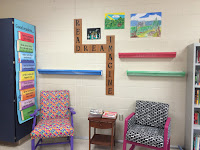
The other big project I did this summer for my room was to re-cover four arm chairs to use in my reading "nooks". Thank goodness for my mother! She came up twice to help me strip, paint, recover, and move my chairs. We always have a great time together, and she is super crafty and has made just about everything! (Currently she is making t-shirt quilts for people, and they are awesome). When we had finished our chairs, we couldn't keep ourselves from admiring them and thinking how awesome we are.


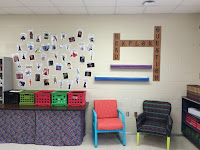
The last time Mom was up, I was finally able to get into my room, so we went up and got started. I had also bought some adhesive cork boards from Oriental Trading (man I love that place) to use on a spot under the clock in my room that is just ugly. I figured I can use the little cork boards as a place to hang announcements and words of inspiration I find during the year. I also hung one of my rain gutter shelves there to use as a place for any extra handouts (I am horrible at just stacking things and then losing them - maybe this will help).


Above are a couple of pictures of what we did. I am all about color this year, probably because the concrete wall rooms often feel like cells (who wants to learn in a cell!). Mom also helped me make some scrabble letters (see them?) out of scrap material my dad had gotten from a site. I am pretty happy so far, only a few things left to do before I am not allowed to lift and move things for several weeks. None of these projects cost me much money, but they do take some time. When it comes to time for my room (a place I sort of live in during the school year), I have no problem spending it!
Sunday, June 28, 2015
Authentic Learning
I started my summer with a trip to Peru with some friends and my husband, and I always forget how much of an authentic learning experience it is when I travel to foreign countries. Especially third world countries. I am also surprised at my ability to speak the language well enough to get us food, lodging, tours, gifts, and directions.
 (South American penguins)
 (The Nasca Lines formation called The Hummingbird)
 (Late night roadblock in the mountains)
 (Eating strange fruit)
Make no mistake though, I am far from fluent.
We began in Lima and over the course of the first few days we worked our way to Parancas, Nasca, Abancay, and Puno. We spent lots of time crammed together in our RAV4. Those are the times you are thankful for several things: (a) You are not on a bus; (b) you know your travel partners well; and (c) being the smallest, and therefore least uncomfortable, person in the car.
As we travelled and were amazed by things constantly, I began to think about the experiences my students have in my classroom. I was also reading The Book Whisperer by Donalyn Miller and The Dissertation Journey by Dr. Roberts, so thinking about my teaching was not far from my mind - regardless of the excite my of the Andes mountains and seeing llamas roaming free.
Like my students, I got frustrated when trying to accomplish a task and had additional requests made by my travel companions. I was not angry, just felt I had to do it all at once and effectively. Needless to say, it was not always effective.
As I waited in a rotisserie chicken place in some little town in the mountains, I mused at the little boy who seemed to run the restaurant. I watched as he took orders and ran for change. When he asked me where we were from and where we going, I told him. Then I noticed him talking to his aunt excitedly. I can't be sure what he told her, but I think it was that he was excited to have met someone from Texas. That moment was purely authentic for him, and one we hope he will share with his classmates - assuming he has the opportunity to go to school.
That experience is something I hope I offer my students, and each summer I find myself reworking things to try and make my class more authentic.
Last year I had two sections of senior English students who had not yet passed the state assessment test or tests. After lots of hard work I was able to get almost all of them past it so they could graduate. What I noticed, however, was the ones who struggled most were primarily my native Spanish speakers. No matter what we did, they struggled with the test because of the reading. I should have read more stories with them, after all they clearly had not gotten what they needed from their previous English classes.
So as I continue is to trek through Peru and be amazed at what I see, do, and know, I will continue to think about what my kids need for their learning to be more authentic next year. We will read more stories, some I will read with them and others I will have them read in class. They will have to reflect on those stories and think about them. My hope is that exposing them to more varieties of literature will help them not only pass the test but have authentic conversations about ideas and texts.
Prepping for Next Year
I have begun prepping for next year, in addition to writing the proposal for my dissertation. As a part of my preparation, I have decided to try using interactive notebooks with my kids. I honestly had not even thought about them until I came across the blog eatwriteteach.com while searching for teacher blogs to use in my proposal. When I saw her Smash Books, I knew they were genius!

I have been taking writing breaks and building my book, which I'm calling the "Frame" of Reference (it makes me giggle every time).
Today, as a part of my book, I decided to create a flip calendar for the year! I'm really pleased with how it came out.
I'll be posting the temate on my Teachers Pay Teachers store soon!
Friday, April 17, 2015
Testing after THE TEST?!
For many of us, especially in Texas, once the STAAR test is done we struggle to keep students interested in classroom activities. They have had so many years of standardized testing that for many of them it seems to be ingrained that the only important thing during spring semester is THE TEST. We teachers know differently. If you are like me, this is the time of year you have saved for the more creative and active lessons, like reading classical plays and pushing kids (in my case even further) to think and support their thoughts. The reality of the struggle is tough, especially when it comes time to give a unit test.
This time of year, I expect that my students have learned to think for themselves, question a text and are able to explain themselves. Since that is my expectation, I have been known to give them non-multiple choice tests. For instance, one of my favorites is called a Responsibility Pie Chart. I got this from one of my master's classes years ago and it has never disappointed me. The chart was created by the great Kelley Gallagher in his book Deeper Reading, and I have watched students sit and scratch their heads for the majority of a period to make a decision.
I used it with Oedipus Rex and my sophomores this week and it is always interesting to see who or what they feel is responsible for the outcome of the play. The best part is that they have to justify themselves too, so they are actually thinking about the play and not just which letter to choose!
If I could give every test all year long this way, I think I would. For an English class it is one of the best assessment tools I've ever seen!
Tuesday, October 28, 2014
The Problem of Vocabulary
I have been "teaching" SAT vocabulary pretty much the same way for years, and for years I've been frustrated with it. I struggle with how to teach general words (i.e., without a specific context going on) and usually feel like I'm failing at it. I like having an SAT word quiz every week because as an English teacher, that gives me an objective grade.
As I've been updating my grades, I am frustrated that so many of my students do poorly. I want to teach them how to study, but I forget that they don't know how to study. I can put the words on a flashcard app and for many that helps, but for others it is an afterthought. So I've decided that next six weeks I need to do something different. I need to find a way to take the time, that oh so important and valuable time to help them learn their weekly SAT words - words that they will see in future texts, on tests, and many they may even hear in video games.
So I've gone on a search. We have ten different words every week, more than that per week I believe is too much. I've found some really great ideas, some that I will begin instituting tomorrow: Create a movie trailer using the words in the description and the title; create a screen name with several of the words; the always famous vocabulary bingo (which may make me alter how many words I use per week); and texting a message using the words.
I've got lots of thinking to do for next six weeks, and it needs to be something that will not add additional grading to my already full week. I truly want to be the best teacher I can be for my kids, and that means I need to make some changes, and make them quickly. Students today don't know how to study and we don't have the time to teach them, the least I can do is institute some sneaky skills in my classroom.
Wednesday, April 23, 2014
Thinking Creatively
Sir Ken Robinson says that schools are training the creativity out of kids, and to a certain extent, I don't disagree. It seems the focus of education lately has become the test. That is certainly supported by all the parents who are opting their kids out of the STAAR test here, but when I see things like the artistic representations my 7th/8th graders presented today for a section of The Little Prince, my faith in creativity is restored.
I chose to have my 7th/8th grade class read The Little Prince because it is beautiful and has the potential to change one's view on the world. One of my girls told me that after reading it, she'd never look at the sky the same way.
I asked my class to choose a part of the book that for them scored an 8 on a scale of 1 to 10 (10 being the most beautiful section for them), and told them to create an artistic representation of that text. At first, like with all new things and teenagers, they hemmed and hawed and didn't think they could do it. Granted, it took a bit of a stern talk about pushing themselves and not just getting stuck where they are now before they truly took off with it.
Today they presented. We had drawings and paintings, but my favorite was from the same girl who said she'd never look at the sky the same way again. She and her father have a ritual of taking pictures of the sunrise each morning and sharing them with one another. She explained that that ritual makes the sunrise special to them. The part she chose in the book is where the Little Prince discovers a rose garden and finds that the flower he loves on his planet is not the only one in the universe. That moment he begins to realize, after some education by a fox who wanted training, that even though his flower was not actually the only one in all the universe that she was special because he loved her and cared for her. For my student, her sunrises are the same. She said that we know the sun will rise each day, but we don't know what it will look like. For several days she made sure to take her sunrise pictures facing approximately the same spot to help illuminate her point. Her pictures tell the story. Like the prince, we don't always realize how special the sunrise is or the little things that we labor to keep going are, but when it finally dawns on us (no pun intended) we know that even though everyone else can see it too (or like the rose there are many) it is special because it is part of a ritual in our lives.
Here are the sunrises she shared with us today in class, they are each from a different day and are in no particular order (the last is my favorite):
As she shared we all remarked at how amazing her photos are of the sunrises we don't always stop to enjoy. We, like the Little Prince, have taken things for granted much like he did his rose. We know the sunrises will be there, but shouldn't we stop and enjoy them on occasion.
This student has not had the creativity trained out of her, and she can see past the standardized tests and into the beauty of the world around her and the rituals that make her life special. How can you help your students to find creativity and joy in their learning process?
Thursday, February 13, 2014
Tension in Learning
My 5th thru 8th grade classes are beginning our Holocaust units, and today I did something completely different with my intro than I've ever done before. I scared them - hopefully no scarring occurred. Please don't misunderstand, the kids knew they were in a safe environment and I asked them to suspend our normal reality and enter into one I wanted them to experience. They all willingly followed me into a new, and ultimately scary experience.
We will never, hopefully, truly be able to experience what the victims of the Holocaust went through; however, today's kids need some sort of connection to the fear, danger, and emotions involved in order to truly empathize with the stories of those who lived and died. I began this experience today with a statement to my kids very similar to that one, and they seemed a little lost. Kids today typically think that if they do not get to play a video game everyday then their lives are miserable, and luckily, they do not have to face such obvious and forced persecution. Most kids (at least the ones I've worked with) don't know true fear, loss, misery, hungry, or injustice. All people today have experienced some level of those, please do not think me ignorant, and there are certainly kids today who live those things daily, but I needed my kids to have a more empathetic frame of mind before delving into our texts.
They came into the classroom and I had taped off two boxes, neither of them very large at all. When we began I showed them the "rules" they had to follow in order to succeed. Now, I've played tricks similar to this before with the kids (when I introduced Nightjohn I took their pencils away and wrote their writing prompt in gibberish yet still expected them to write), so they knew something was up.
Here are the rules I gave them to build a card house:
- You may not move out of the provided space, that includes any part of you
- If a card goes outside of the space, you lose
- You may only speak in whispers
- All of your cards must face the same way (only the face of the card may show)
- If you do not succeed, the leader of your group will fail
- You must build your card house so it has at least three stories, or you lose
- You must use all your cards, if you do not, you lose
- You must complete your house by the time the clock stops, or you lose

I did not actually give anyone a zero, I also did not let anyone succeed. I made them uncomfortable by walking around in my "stern" mode, I said things loudly, I kicked down their houses when they were just starting to figure it out, and I changed the amount of time they had to complete the task several times. Neither group was successful, they were all nervous throughout the task however. When it was done, I asked them to sit down, return to our reality, and pull out a piece of paper and reflect on their experiences. I asked them not to talk about it at first.
Here are some of the things they said:
"We were actually getting close to one story, but your friggin' foot just pushed it over! Don't try and tell me it 'brushed up against it'...NO!"
"My heart started beating fast when Mrs. Ranzau walked to us."
"Towards the end I wanted to cry..."
"I seriously considered tripping Mrs. Ranzau, just because I felt like she only walked by us to ruin our work."
"My hands were trembling, and I began to feel quite angry with myself."
"I couldn't stop giggling. I don't know that there was really a reason, but we didn't seem to stop."
My kids were nervous and I could feel the tension rising as the experiment went on. I noticed some kids pull into themselves when I walked past them after knocking something down or pushing their knees back into the box. They were immediately going into survival mode but didn't feel like they had any power to do anything about it.
This got them all thinking about the reality they are about to read about in The Diary of Anne Frank and The Hidden Girl. I don't ever want my kids to feel as if they are in danger, anywhere, but I do want to encourage empathy. Without empathy and some level of understanding, we cannot truly learn from the words so many others have fought to share and protect.
Friday, November 1, 2013
A Classroom Kids Want to Be a Part Of
I teach grades 5-12, and I try to make sure my kids aren't doing the same thing over and over and over again each day. Don't get me wrong, we have certain routines we follow daily to keep us on a path, but I am constantly searching for new ways to teach the same old "boring" stuff.
My freshmen have just finished reading "The Most Dangerous Game" and I had deliberately set it up so they had to read it silently and we haven't really talked about it yet. I asked them to take what they understood about the story and set it in a completely different place so they could play with how the setting affects the text - we did talk about that as they were working. I got some interesting stories, and they were all able to see how things would have changed if the story hadn't taken place on a creepy, deserted island.


I asked them how they felt about doing this project and they all seemed to agree that it made the characters more real for them. I love when my kids make connections to texts, and I LOVE when they enjoy doing it at the same time :)
Students of all ages want to be creative and they want to do something in class where they see value, i.e. authenticity. Don't be afraid to throw a crafty project into the mix, you might be surprised how much the kids can actually get from it.
Friday, September 27, 2013
Teachers: The World's Greatest Thieves!
Ok, maybe we aren't really thieves, but man do we know how to steal and use other people's stuff! As I was preparing for the year I decided to push myself and REALLY be prepared and organized this year. I sat down to write the full units, including rubrics and essay questions, for each book I had asked the kids to read over the summer. I teach grades 5 - 12 so that was quite a task! I had decided at the end of last year not to have the 5th/6th grade class students read a book simply because I wasn't sure whether or not the books would be returned, so that left me with four books to prepare (we currently have no sophomore students).
 As I began my preparations for units that were engaging, incorporated elements of drama and theatre (role play, design, scripting, etc.), and challenging for the kids, I turned to some of my favorite professional texts to see what they had that I could use. With Readicide (Kelley Gallagher), Deeper Reading (Kelley Gallagher), and When Kids Can't Read (Kylene Beers) at my side (along with the trusty Internet), I began to plan and organize. In essence, I was stealing other people's ideas to make myself ready and organized and honestly, it felt great!
There is nothing wrong with using the things other teachers have put out in the open for us and there are some great places to share with teachers: NCTE's Connected Community, a Ning I just joined called English Companion (http://englishcompanion.ning.com) where English teachers from all over can chat and help each other out, TeachersPayTeachers (http://www.teacherspayteachers.com), The English Teacher's Friend (http://www.englishteachersfriend.com) and I'm sure there are tons of others (these are just the ones I use). We shouldn't feel like we need to reinvent the wheel for each lesson, we should take a base and adapt it so the new wheel fits our car. After all, no one has the same passengers as any one else, so why would we want to use exactly the same things?

Steal, invent, adapt, borrow, whatever word works for you see how great it can make you feel!
 As I began my preparations for units that were engaging, incorporated elements of drama and theatre (role play, design, scripting, etc.), and challenging for the kids, I turned to some of my favorite professional texts to see what they had that I could use. With Readicide (Kelley Gallagher), Deeper Reading (Kelley Gallagher), and When Kids Can't Read (Kylene Beers) at my side (along with the trusty Internet), I began to plan and organize. In essence, I was stealing other people's ideas to make myself ready and organized and honestly, it felt great!


There is nothing wrong with using the things other teachers have put out in the open for us and there are some great places to share with teachers: NCTE's Connected Community, a Ning I just joined called English Companion (http://englishcompanion.ning.com) where English teachers from all over can chat and help each other out, TeachersPayTeachers (http://www.teacherspayteachers.com), The English Teacher's Friend (http://www.englishteachersfriend.com) and I'm sure there are tons of others (these are just the ones I use). We shouldn't feel like we need to reinvent the wheel for each lesson, we should take a base and adapt it so the new wheel fits our car. After all, no one has the same passengers as any one else, so why would we want to use exactly the same things?

Steal, invent, adapt, borrow, whatever word works for you see how great it can make you feel!
Monday, July 8, 2013
Planning and Learning
As I sit here eating the most beautiful Fritos pie I've ever seen and scroll through my Twitter feed to see what gems EduDemic has posted lately, I find myself thinking again about how I teach and how I learn.
 We are three weeks into the summer break in west Texas and I've been planning for next year and in my own classes since before graduation. Perhaps that makes me a crazy person...more likely it makes me a teacher who wants to be well prepared as well as create as much challenge and authenticity for my students as possible. I sent books home with almost all of my students and am working to figure out the best way to delve into those books when we return. I want the books to be not only a discussion between us but also something to help my students realize the power of words.
Edudemic posted a link to an article examining the difference between projects and project based learning. Education is always full of trends and I feel like project based learning (PBL) has been one of those for a few years now. I am a fan of projects because I feel they can actually push students to guide their own learning. The article however disagrees, it's author seems to believe that projects are a waste of time and the end result is useless and unauthentic. The author also seems to believe that PBL is the only way to get authenticity from students. I can see where they come from, many teachers assign projects for no real reason. As I read through their list comparing the two I found myself identifying aspects in each column that I use when I assign projects to my students.
 I hope that is a good thing. I never want to give my kids something that is worthless.
Monday, June 3, 2013
All Good Things...
...come to those who wait...and pray...and push...and finagle. This year was a challenge, as I've said before and I am so glad I can see real results! Not only did I get good results with testing (although I HATE standardized testing), I've also seen kids become readers who hated books, have grown some future awesome writers and have seen my kids be able to reflect on their own strengths and weaknesses.
How many of us can truly say our kids are reflective about their own work - and I'm not talking the kind they throw together at the end of the day. As a part of my high school English finals this year I asked my kids to read all of their writing from the year and analyze it. Some had more pieces than others, as is always the case, but for most high school kids it is a daunting task to actually look back and read EVERYTHING they've written over the year.
I was rewarded with some great self-analyses/reflections and my kids seem to have seen what I've seen (things they saw without me telling them to look). The day the kids pulled out the folders from their files in my room and started pulling stuff from their binders I had one immediately say, "This just needs to be burned!" He wasn't referring to the idea that it needed to be burned so he "couldn't" do the assignment. He wanted to burn his work because he thought it was terrible. That is how much he felt he'd grown as a writer!
Here are a couple of gems from some of the analyses I got today, I'm pretty proud!
"As a writer, I think I have improved drastically. My writing is not as sloppy as it used to be. I feel that it has more of a purpose now. My purpose now is to create a vivid mental picture that will keep the reader drawn into the story. In the past, I only tried to write something down to fill space. After discovering that I actually liked writing fictional stories, it felt easier to just draw a picture with my words."
"Even though I have become a better writer, I still feel weaknesses. When I write, I sometimes have a hard time beginning my writing and focusing. It's still difficult for me to start off my stories and papers because I can't focus. I usually spend a long time, at times hours, trying to come up with a beginning. I wonder sometimes if there's a way to help me think better so I can find good ways to start my papers."
Saturday, May 25, 2013
Winding up
As the year finally draws to a close, I am forced to look back at everything that has happened this year and breathe a sigh of relief. Going from a huge 5A school (with approximately 1500 students in 7th and 8th grade alone) to the smallest school in the state (8 high school students) this year has been more of an adjustment that I could ever possibly imagine.
I've always considered myself a good teacher, but I never fathomed how long it would take me to adjust lessons meant for 25 or 30 so they would work for 2 or 4. My students and I were able to accomplish so much this year, I honestly think many of them were surprised at how they grew and how much they read. One of my boys is finally becoming a reader (which means I want to make sure I've got lots of stuff he'll want to read next year, so if you've got suggestions please let me know). One of my girls went to state competition for one of her essays (a HUGE deal in our little town that is usually ignored), both of my seniors got into their first choice schools and have received multiple scholarships. Several of my students are freely writing stories to send into a fiction contest this summer (how cool is that!). And overall I truly believe they have a solid foundation now.
Since they've grown so much I feel I can push them, and myself, harder next year. I've already started planning and luckily my best friend is willing to help! Teaching 5th thru 12th grade takes A LOT of planning! I found several books this year that I'm ready to delve into to find some new and exciting stuff for my classes. I'm also getting ready to start my 3rd semester of my doctoral program :)
The goals and growth this year has produced for both me and my students has been astounding and I hope I can continue to help my students grow while I'm there.
I hope to do more regular postings this summer as I continue to plan and learn!
Monday, April 8, 2013
Spring has Sprung!
As I sit in my empty classroom, all of my students are off at spring sports competitions, I can't help but feel overwhelmed. Finishing my second semester as a doctoral student, preparing my seniors for graduation and ultimately moving away to college and hoping to continue to affect positive change for those who will be in my classroom next year is proving heavy this spring. All I really want to do is enjoy the weather and stare at the mountains with the sun shining on them.
Alas, I am a much better student AND teacher than that! My biggest struggle is currently finding articles for a literature review for one of my classes. My review is supposed to be related to my dissertation topic, which makes sense, BUT there seems to be very little research in that vein. My prof said I should read at least 50 articles before I really start writing and exploring the themes....that is amazingly hard! I can't find a whole lot of articles and I feel like this paper might win :(
Subscribe to:
Posts (Atom)